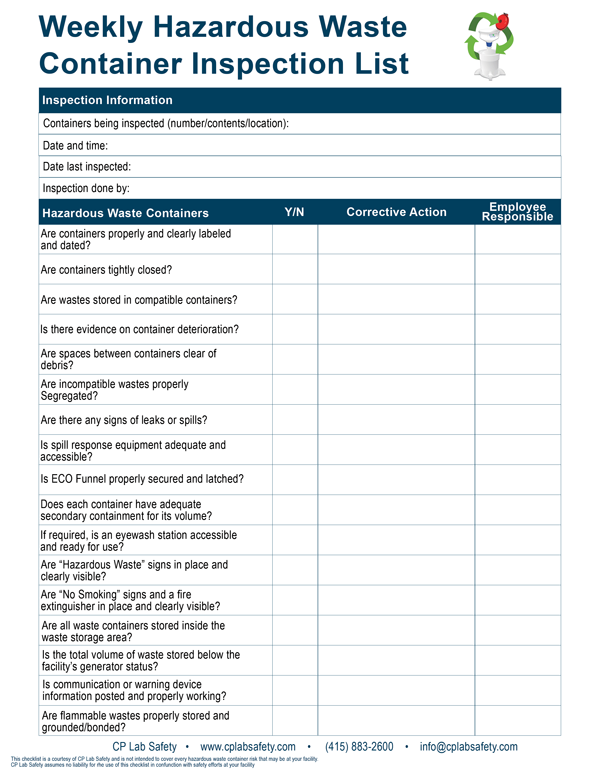
Hazardous Waste Container Inspection Checklist
At CP Lab Safety we're always working to find ways to keep your business running and your staff healthy and safe! This weekly hazardous waste container inspection checklist will help you stay compliant with regulations and ensure your chemicals are being handled properly. Implementing routines for weekly inspections is key to maintaining a safe and efficient workplace.
Will Your Lab Pass Inspection?
Hazardous & Flammable Waste Container Compliance Checklist
Laboratory inspections for hazardous waste are straightforward in principle but strict in execution. Most violations are not complex—they are small, visible issues: open containers, vapor release, incomplete labels, or incompatible storage.
This checklist reflects how inspectors evaluate hazardous and flammable waste containers under California requirements aligned with EPA and fire code standards.
- Container Condition
- Container is in good condition (no cracks, leaks, rust, or bulging)
- No visible chemical degradation or damage
- Suitable for repeated use (not improvised or disposable)
Fail if: damaged, leaking, or visibly degraded
- Chemical Compatibility
- Container material is compatible with the waste (no reaction, softening, or permeation)
- Incompatible wastes are not mixed
- Manufacturer compatibility data is available if needed
Fail if: container shows signs of reaction or incompatibility
- Closed Container Requirement
- Container is closed at all times except when actively adding waste
- Lid or cap is tight-fitting and secure
- No funnels left open
- No foil, parafilm, or loose coverings
Fail if: container is open, venting, or loosely covered
- Vapor Control (Critical for Flammable Waste)
- No detectable solvent odor escaping the container
- System minimizes vapor release during use
- Closure is effectively vapor-tight between uses
Fail if: vapors are continuously escaping, even inside a fume hood
- Labeling
- Labeled “Hazardous Waste”
- Full chemical names listed (no abbreviations)
- Hazard indicated (e.g., Ignitable, Corrosive, Toxic)
- Accumulation start date included where required
Fail if: missing required label elements or using abbreviations only
- Secondary Containment
- Appropriate secondary containment is in place where needed
- Capacity meets requirements (10% of total volume or 100% of the largest container)
- Containment materials are compatible with stored chemicals
Fail if: no containment where spills are possible
- Storage & Fire Safety (Flammable Waste)
- Stored away from ignition sources
- Located in appropriate areas (e.g., fume hood or designated storage)
- Flammable cabinet used if required
- Containers are stable and not at risk of tipping
Fail if: ignition risk or improper storage conditions are present
- Quantity & Location
- No more than 55 gallons per waste stream in satellite accumulation areas
- Located at or near the point of generation
- Under control of the operator
Fail if: limits are exceeded or containers are improperly located
- Inspection & Maintenance
- Containers are inspected regularly
- No buildup, leaks, or deterioration
- Compromised containers are removed from service
Fail if: lack of routine inspection or obvious neglect
Quick Pass / Fail Summary
PASS if:
- Container is closed and vapor-tight
- Materials are compatible
- Labeling is complete and accurate
- No visible damage or leaks
- No ongoing vapor release
FAIL if:
- Container is open or left open between uses
- Detectable solvent odor is present
- Closure is improvised or unsecured
- Container is degraded or incompatible
- Labeling is missing or incomplete
What Inspectors Actually Flag
In practice, most citations come from a short list of issues:
- Open funnels on solvent waste containers
- Containers left open “temporarily”
- Strong solvent odor indicating vapor release
- Missing “Hazardous Waste” labeling
- Use of abbreviations instead of full chemical names
Practical Considerations for Passing Inspection
Maintaining compliance consistently comes down to control:
- Containers must remain closed even during routine use
- Vapor release should be minimized, not just ventilated
- Systems should support safe, repeatable waste handling without relying on manual steps
In many laboratories, challenges arise not from lack of knowledge, but from workflow—frequent waste additions, multiple users, and the tendency for containers to be left open during active work.
Designing waste collection setups that maintain closure during use helps reduce variability, improve safety, and align day-to-day practices with inspection expectations.
Bottom Line
If your containers are closed, compatible, properly labeled, and not releasing vapors, you are aligned with what inspectors are looking for.
Most failures are visible and preventable. A quick walkthrough using this checklist will identify the same issues an inspector would see.
Back to Laboratory Safety: A Guide to Risk Reduction in Modern Labs
Download the Hazardous Waste Container Inspection Checklist (PDF)