
Waste Compatibility by Chemical Group
The Dangers of Mixing Incompatible Waste Streams
Segregating incompatible chemical waste is one of the most important parts of laboratory safety. When incompatible waste streams are mixed, dangerous reactions can occur that may lead to serious injury, equipment damage, fires, explosions, toxic gas release, heat generation, pressure buildup, or violent container failure.
Proper waste segregation helps protect employees, facilities, and the environment while supporting regulatory compliance. You can use our Waste Compatibility Charts to help determine which chemicals can and cannot be stored together safely.
Proper Labeling Prevents Dangerous Mixing
All waste containers should be clearly and accurately labeled so only compatible chemicals are added. Labels should remain readable, durable, and preferably moisture-resistant.
If labels become faded, washed out, damaged, or unreadable, the contents may require costly analytical testing before disposal. Maintaining labels is far less expensive than identifying unknown waste after the fact.
Recommended label information includes:
- Chemical names or approved waste stream name
- Major hazards
- Accumulation start date when required
- Department or user identification
- Fill limits or handling notes
Color Coding Improves Waste Safety
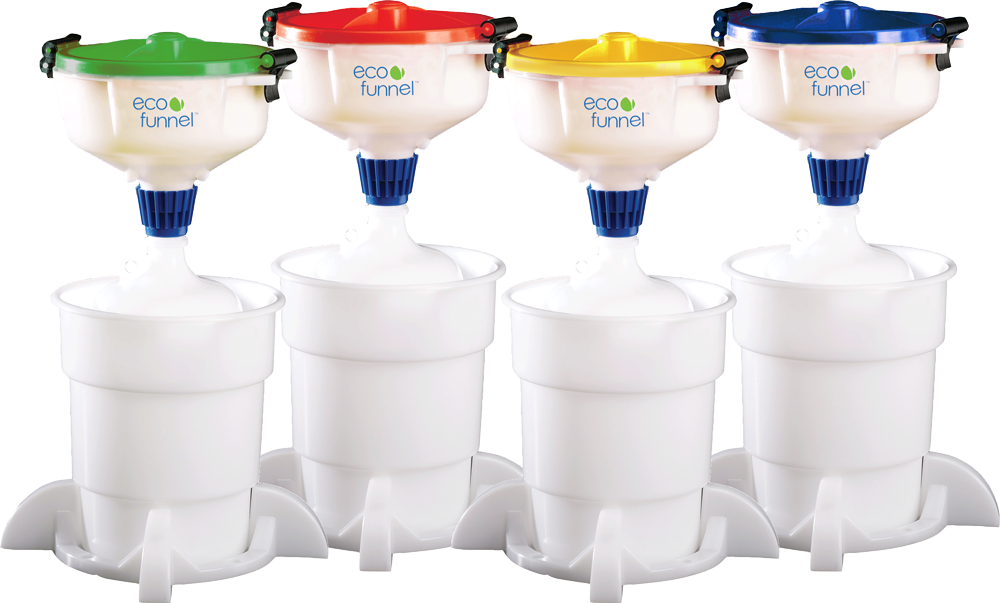
CP Lab Safety recommends going beyond minimum labeling requirements by using a clear color-coding system so workers can immediately recognize the correct waste container.
Many laboratories create internal color standards for:
- Flammable solvent waste
- Acid waste
- Base waste
- Halogenated solvent waste
- Heavy metal waste
- Oxidizer waste
CP Lab Safety manufactures ECO Funnels in multiple lid colors to simplify laboratory waste segregation and reduce accidental cross-use.
As a General Rule, Never Mix These Groups
- Acids and alkalis
- Spontaneously combustible materials and acids
- Acids and flammables
- Acids and cyanides
- Acids and reactive sulfides
- Oxidizers and organics
- Nitrates and acids
- Ammoniated compounds with hypochlorites or bleach
- Organic nitrates/perchlorates with oxidizers or metals
- Azides with metals, metal salts, acids, strong oxidizers, or halogens
- Perchloric acid with metals, charcoal, ethers, organics, combustibles, or many acids
Common Incompatible Combinations Linked to Laboratory Incidents
Acids and Bases
Can generate significant heat, splashing, and boil-over.
Acids with Bleach, Azides, Cyanides, Sulfides, Metals, or Carbides
Can release highly toxic or flammable gases.
Nitric Acid or Perchloric Acid with Organics
Even dilute solutions may generate heat, oxidation, or fire.
Acetic Acid, Acetic Anhydride, and Formic Acid
These materials have both acidic and organic characteristics. Concentrated forms may be flammable and should not be mixed with mineral acids without evaluation.
Peroxides with Organics or Metals
May initiate fire or rapid decomposition.
Inorganic Nitrate Salts or Bases with Organics
May form unstable compounds capable of detonation.
Ammonium Nitrate or Hydroxylamine Nitrate with Organics
Can create severe explosion hazards.
Potassium Permanganate and Sulfur
May cause flash fires.
Nitromethane with Bases, Amines, Metals, or Metal Compounds
May react violently.
Piranha Solution with Organics or Metals
Can cause violent reaction, fire, rapid gas generation, or overpressurization.
Azides and Metals
Can form shock-sensitive metal azides.
Chloroform and Acetone with Base
May react dangerously.
Monomers with Iron, Acids, or Water
Some monomers may polymerize violently.
Acetic Anhydride with Water, Glycols, or Alcohols
Can release heat and react vigorously.
Safe Waste Management Best Practices
- Keep separate, labeled containers for each waste stream
- Use closed waste containers except when actively adding waste
- Train employees on incompatibility hazards
- Use secondary containment trays
- Do not guess when combining wastes
- Review SDS information before disposal
- Inspect waste stations regularly
Use Waste Compatibility Charts
Our Waste Compatibility Charts make it easier to avoid accidental mixing of incompatible chemicals. You can view them online or download printable copies for your laboratory files.
These charts use chemical groups aligned with United States Environmental Protection Agency waste compatibility guidance.
Summary
Mixing incompatible waste streams is one of the fastest ways to create a laboratory emergency. Proper labeling, segregation, color coding, and compatibility review dramatically reduce the risk of fires, toxic releases, and injuries. A small amount of prevention can avoid a major incident.
Waste Compatibility Charts by Chemical Group:
- Alcohols and Glycols
- Aldehydes
- Aliphatic and Aromatic Amines
- Amides
- Aromatic Hydrocarbons
- Azo Compounds, Diazo Compounds and Hydrazines
- Carbamates
- Caustics
- Combustibles and Flammables
- Cyanides
- Dithiocarbamates
- Esters
- Ethers
- Explosives
- Fluorides
- Halogenated Organics
- Inorganic Sulfides
- Isocyanates
- Non-oxidizing Mineral Acids
- Organic Sulfides and Mercaptans
- Oxidizing Mineral Acids
- Ketones
- Metals - Alkali and Alkaline Earth
- Metals and Alloys as Powders, Vapors or Sponges
- Metals and Alloys as Rods, Sheets and Drops
- Metals - Toxic
- Nitrides
- Nitriles
- Organic Acids
- Organic Nitro Compounds
- Organic Peroxides and Hydroperoxides
- Organophosphates, Phosphiothioates and Phosphodithioates
- Phenols and Cresols
- Polymerizable Compounds
- Saturated Aliphatic Hydrocarbons
- Strong Oxidizing Agents
- Strong Reducing Agents
- Unsaturated Aliphatic Hydrocarbons
- Water and Water Mixtures